
Guides › Sporting clays vs skeet vs trap vs 5-stand
Sporting clays vs skeet vs trap vs 5-stand: what's the difference?
By Clays Finder  Support Clays Finder
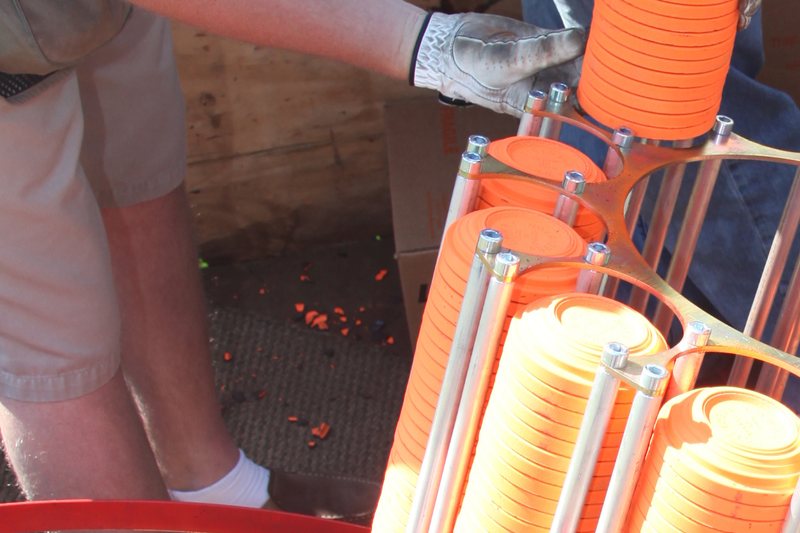
All four games have you shooting clay targets with a shotgun. They differ in how fixed the targets are:
- Trap and skeet throw the same target paths on every field, so you can practice the same shots again and again.
- Sporting clays changes from course to course and station to station.
- 5-stand puts a sporting-style mix of targets on one compact field.
The rules below come from the bodies that govern each game:
- NSCA (National Sporting Clays Association) for sporting clays and 5-stand
- NSSA (National Skeet Shooting Association) for skeet
- ATA (Amateur Trapshooting Association) for American trap
Casual rounds at a range can be looser than these tournament rules, so ask the range how it runs things.
At a glance
| Sporting clays | 5-stand | Skeet | Trap (ATA) | |
|---|---|---|---|---|
| Layout | A course of 10–15 stations around fields or natural terrain | Five stands in a straight line, with 6 or 8 automatic traps recommended | 8 stations: 7 in a half-moon between two trap houses, plus 1 in the center | 5 posts, 3 yards apart, 16 yards behind one trap house |
| Targets | Varied speeds, angles, distances and sizes. No two courses alike | A set sequence ("menu") posted at each stand | High house and low house, with the same paths every round | Thrown away from you from one trap, at an angle the shooter doesn't know in advance (within set limits) |
| Usual round | 50 or 100 targets | 25 targets | 25 targets: 17 singles and 8 doubles | 25 or 50 targets per field in ATA events |
| Squad | 2–6 shooters | Five stands, with shooters rotating | Up to 5 | 5 in ATA events |
Sporting clays
The NSCA calls sporting clays "golf with a shotgun":
- The course. Courses simulate hunting ducks, pheasants, upland birds and rabbits. The NSCA notes there's "no set season."
- Stations. Each station throws targets on its own paths, with varied speed, angle and distance. The NSCA lists six sizes of targets.
- Pairs. Targets come as singles or pairs. In a report pair, the second target launches at the sound of the first shot. A following pair comes from the same trap. A true (simultaneous) pair launches both at once.
- Shots. On a single target, you may fire two shots. It counts if either shot breaks it.
- Guns. Under NSCA rules, guns must be 12 gauge or smaller and able to fire two shots, with no more than two shells loaded. The NSCA says 12 and 20 gauge are the most popular.
Find sporting clays ranges near you · browse by state
5-stand
5-stand is the NSCA's compact version of sporting clays. Under its rules:
- Rounds. Shot in 25-bird increments from five stands, with shooters rotating between stands.
- Traps. 6 or 8 automatic traps are recommended.
- Menu. Each stand has a menu card showing which targets come, and in what order.
- Stands. The stands are in a straight line.
- Safety. Your gun stays open and empty while you change stands, and you load only in the stand.
It's the second most-listed game in Clays Finder: 282 of the 390 public sporting clays ranges offer 5-stand.
Skeet
Per the NSSA:
- The field. Two trap houses sit at either end of a half-moon. The high house releases its target 10 feet up, and the low house releases its target 3½ feet up. Both targets rise to 15 feet at the center of the field.
- Stations. Eight: seven around the half-moon plus one in the center.
- A round. 25 targets: 17 singles and 8 doubles. Your first miss is repeated right away. That's called the "option."
- Squads. Up to five shooters, moving from station to station.
- Guns. Any gauge that can fire at least two shots. The NSSA says the preferred shot size is #9, and nothing larger than #7½ should be used.
Trap
In American trap, per the ATA's rules:
- The field. You shoot from five posts 3 yards apart, 16 yards behind a single trap house.
- The targets. Singles are thrown 49 to 51 yards, and they're 8 to 10 feet high at 10 yards out. The trap throws at an angle you don't know in advance, within limits set by the rules.
- The events:
- 16-yard singles: 5 or 10 shots at each post, rotating.
- Handicap: from 19 to 27 yards back, based on ability.
- Doubles: two targets at once, from 16 yards.
- Squads. Five shooters in ATA events.
Other games you'll see listed
- FITASC (Parcours de Chasse). The NSCA rule book includes FITASC sporting, defined as "a shooting discipline reproducing hunting situations." FITASC is shot on layouts of singles and doubles, under its own rules.
- Super Sporting. An NSCA format with at least 3 traps per stand. Otherwise NSCA sporting rules apply.
- Wobble trap. A trap variation offered by some ranges. Formats vary, so ask the range.
How many ranges offer each
From Clays Finder's 612 U.S. sporting clays listings, as of Nov 20, 2026 (Public counts only ranges whose own website says they're open to the public):
| Discipline | All ranges | Public ranges (of 390) |
|---|---|---|
| Sporting clays | 612 | 390 |
| 5-stand | 411 | 282 |
| Trap | 340 | 208 |
| Skeet | 309 | 192 |
| Wobble trap | 64 | 49 |
| FITASC | 43 | 30 |
| Super sporting | 34 | 27 |
| Bunker trap | 14 | 13 |
| Olympic trap | 6 | 6 |
| ZZ / Helice | 13 | 6 |
217 ranges list all four main games (sporting clays, 5-stand, trap and skeet), and 141 of those are public. 93 list sporting clays only.
Trap, skeet and 5-stand are often priced per 25-target round. A few examples, as posted by the ranges:
- Island Lake Shooting Range, Brighton MI: 5-stand $12.50 per 25, skeet or trap $11 per 25 (public rates).
- Elk Creek Hunt Club & Resort, Owenton KY: 5-stand $15 per 25 (non-member).
- Old Forge Sporting Clays, Providence Forge VA: 5-stand $16 per 25.
Which should you try first?
That depends on what the range offers and what you want. Trap and skeet repeat the same targets, so they're good for practice. 5-stand gives you sporting-style variety without a long walk. A full sporting course takes longer and covers the most ground.
Many ranges offer lessons. Ask the range what it recommends for a first visit.
Find a range: search by ZIP · browse by state · upcoming events
Related guides: How much does sporting clays cost? · Your first round: what to expect, wear and bring · 5-stand sporting clays · Public vs members-only sporting clays · Sporting clays targets explained · FITASC vs super sporting · All guides
How we got these numbers
- Discipline and access counts come from the
disciplinesandaccess_typefields for all 612 U.S. sporting clays ranges in Clays Finder's listings data, as of Nov 20, 2026: 612 sporting clays ranges in 50 U.S. states, of which 390 are Public. These field totals are for the United States only; grounds in Canada and the UK are listed separately and are not included. - Per-round prices come from the ranges' price notes, each citing the range's own website. Island Lake's was rechecked on its site on Oct 26, 2026.
Sources
- NSCA, "What is Sporting Clays?": https://nsca.nssa-nsca.org/what-is-sporting-clays-2/
- NSCA, "Sporting Clays Basics": https://nsca.nssa-nsca.org/sporting-clays-basics/
- NSCA 2026 Rule Book (updated 4/22/26), covering shotgun and gauge rules, pairs definitions, 5-Stand, Super Sporting and FITASC: https://nsca.nssa-nsca.org/wp-content/uploads/sites/7/2026/04/2026-NSCA-Rule-Book-4-22-26.pdf
- NSSA, "Skeet Basics": https://mynssa.nssa-nsca.org/skeet-basics/
- ATA Official Trapshooting Rules (2027 rulebook), covering posts, target flight, events and squads: https://shootata.com/portals/0/pdf/rulebook.pdf
- ATA, "Trapshooting Overview": https://shootata.com/General-Information/Trapshooting-Overview
- Island Lake / Michigan Shooting Centers pricing: https://mishoot.com/pricing/
- Clays Finder listings data (
ranges.json).
last_checked: 2026-11-12