
Guides › How sporting clays scoring works
How sporting clays scoring works: pairs, scorecards and NSCA classes
By Clays Finder  Support Clays Finder
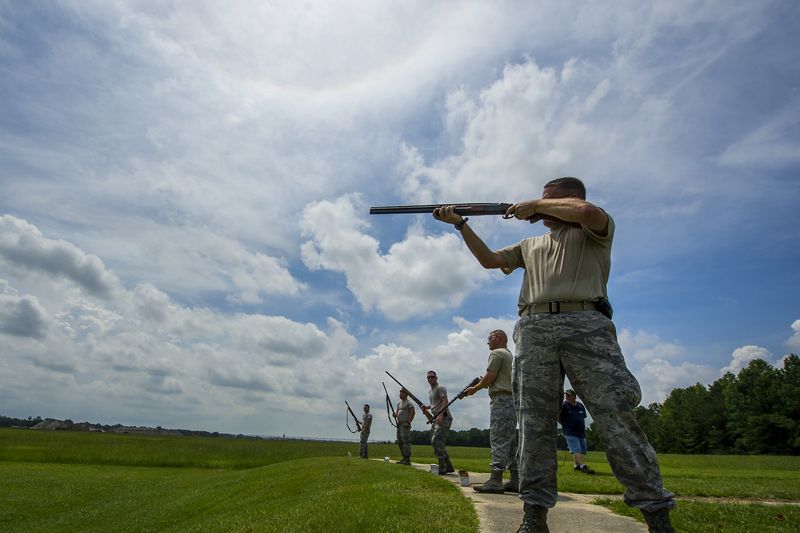
Scoring is simple: you get one point for every target you break and nothing for a miss, so a 100-target round tops out at 100. The only wrinkles are how pairs work and what happens when something goes wrong, like a gun that won't fire. This guide walks through the NSCA's scoring rules in plain English, then explains NSCA classes and what a "good" score looks like.
Casual rounds at a public range can be looser than tournament rules, so ask the range how it scores. The rules below come from the NSCA (National Sporting Clays Association), the governing body for the sport in the U.S.
What counts as a hit
- Broken is dead. The NSCA's own basics page says a target is a "dead bird" if any part of it is broken. The rule book adds that a target that is hit but not broken (a "dusting") is scored as lost.
- The referee decides. At registered shoots a field judge calls each target "dead" or "lost" and marks the scorecard: a slash ( / or \ ) for a dead target, and an "O" for a lost one.
- You can ask, but only right away. If you disagree with a call, you have to say so before you shoot at another set of targets or leave the station. The judge's decision is final.
- Check your card. In a registered event you must verify your score before you leave the station. Once you've left, it's final.
Singles and pairs
At each station a menu card says what's thrown and in what order. Targets come as singles or pairs.
Singles. You get two shots at a single target. It's dead if either shot breaks it.
Pairs. You get two shots in total, and you can score a maximum of two hits. The rule book defines three kinds:
| Pair | What happens | If you miss the first target |
|---|---|---|
| Report pair | Two targets, one after the other. The second is launched at the sound of your first shot. | You may fire your second shot at the first target again. It's scored on the first target, and the second target is scored lost. |
| Following pair | Both targets come from the same trap on the same path, one right behind the other. You may shoot them in either order. | Same as a report pair. |
| True pair (simultaneous) | Both targets are launched at the same moment. You may shoot either one first. | You may fire your second shot at the same target. |
If you break both targets of a pair, with either your first or second shot, that's two hits.
A worked example
Say a station's menu is a single, then a report pair, then a true pair. That's five targets, so five points are possible.
- You break the single with your second shot: 1 point.
- On the report pair, you miss the first target, then break it with your second shot. The first target counts and the second is scored lost: 1 point out of 2.
- On the true pair, you break one target with each shot: 2 points.
That's 4 out of 5 on the station.
When something goes wrong
The rule book has its own handling for no-birds and malfunctions, so one bad moment doesn't have to cost you points:
- No-bird on a true or following pair. Nothing is scored. Two good targets have to be thrown before the pair counts.
- No-bird on the second target of a report pair. The result of your first shot stands, and you repeat the pair to score the second target.
- Gun or ammunition malfunction. You get a combined total of three per day, per event. Targets you couldn't attempt on those three are no-birds. After that, they're scored lost.
- Shooter mistakes. Leaving the safety on, forgetting to load, or not seeing the target is scored lost.
The rule book says field judges are the people who make these calls, so keep your gun pointed safely downrange and wait for the ruling.
NSCA classes
If you shoot registered NSCA events, you'll be put in a class so you compete against shooters of similar ability. Class isn't based on a single score. It mostly depends on how you place against other shooters in your class over time.
- Six classes. From highest to lowest: Master, AA, A, B, C, D. A shooter who has never shot registered clay targets is assigned C class in 12 gauge, and D in sub-gauge.
- You move up by earning "punches." Punches go to the high scores in your class at a registered event, and the number depends on how many shooters are in the class. For example, in a class with 10 to 14 entries the top score earns two punches and second place earns one.
- How many punches you need. In 12 gauge, a D shooter needs 4 punches to move to C, C needs 6 to move to B, B needs 10 to move to A, A needs 18 to move to AA, and AA needs 25 to move to Master.
- Within a year, class only moves up. The rule book says a shooter is subject to reclassify upwards only during the current year, with the exception of appeals. Registered events of 50 or more targets generate punches. The NSCA can also reclassify a shooter based on "known ability."
- Extra categories. Many shoots also offer "concurrent" events by age (Sub-Junior, Junior, Veteran, Super Veteran, Senior Super Veteran and Legacy) or for Ladies, in addition to class awards.
If you only shoot casual rounds at public ranges, you don't have a class. Classes are part of the NSCA's registered-shoot system.
What's a good score?
There's no single number, because every course is different. Courses are set differently, targets vary, and weather matters. The NSCA's rule book itself says target number, selection and order are up to shoot officials. So a 70 on one course and a 70 on another can mean different things.
Two comparisons are more useful than the raw number:
- Yourself on the same course. If you shot 58 last month and 64 this month on the same course, you improved.
- Your class at the same shoot. Registered shoots rank you against shooters in your own class, which is why the NSCA classes exist.
For a sense of scale, here's one real example. At the October 2026 NSCA main event at Blackjack Sporting Clays (Sumterville, FL, Oct 24, 2026), 99 shooters shot 100 targets. The independent site ClayCurves, which builds tables from public Score Chaser results, reports that the middle score for the event was 81 and the average 78.5. By class, the middle scores were:
| Class | Shooters | Middle score (median) |
|---|---|---|
| Master | 26 | 86.5 |
| AA | 16 | 82 |
| A | 11 | 83 |
| B | 17 | 78 |
| C | 17 | 69 |
| D | 9 | 71 |
That's one club on one day, so don't treat it as a benchmark for your local range. It does show that even in the lowest classes, the middle shooter at a registered shoot broke around 70 of 100.
Find a range: search by ZIP · browse by state · upcoming events
Related guides: Your first round: what to expect, wear and bring · How much does sporting clays cost? · Sporting clays vs skeet vs trap vs 5-stand · Fall and winter sporting clays shoots · Sporting clays targets explained · All guides
How we checked
- Rules come from the NSCA 2026 Rule Book (updated 4/22/26): scoring and score cards (Section VII, "Scoring Procedure"), pairs (Tournament Equipment), no-bird and malfunction handling, and Classification (Section V). We read the live PDF on Nov 18, 2026. The rule book's section numbering is not always consistent, so we cite headings and printed page numbers.
- The "dead bird" wording comes from the NSCA's "Sporting Clays Basics" page.
- The Blackjack example is from ClayCurves, an independent site that says it is not connected to Score Chaser or the NSCA. Its figures are a third-party tabulation, not official results. We opened the page on Nov 18, 2026.
- Clays Finder lists Blackjack Sporting Clays as a public range in Florida: Blackjack Sporting Clays.
Sources
- NSCA 2026 Rule Book (updated 4/22/26): Section V "Classification" (printed pp. 15–19, 23–25); Tournament Rules "Tournament Equipment, Pairs" (p. 36); "Target Presentation and Scoring" and "Scoring Procedure" (pp. 49–52); "Malfunctions" (pp. 52–53): https://nsca.nssa-nsca.org/wp-content/uploads/sites/7/2026/04/2026-NSCA-Rule-Book-4-22-26.pdf
- NSCA, "Sporting Clays Basics": https://nsca.nssa-nsca.org/sporting-clays-basics/
- NSCA, "What is Sporting Clays?": https://nsca.nssa-nsca.org/what-is-sporting-clays-2/
- ClayCurves, October 2026 NSCA results (Blackjack Sporting Clays, Oct 24, 2026): https://claycurves.com/shoots/october-nsca-2026-fl/
- Clays Finder listings data (
ranges.json).
last_checked: 2026-11-18