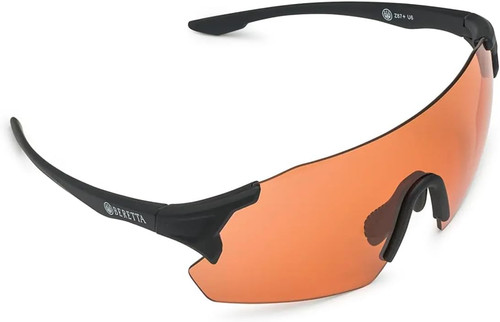
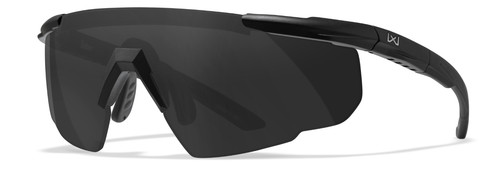
Clays Finder is a participant in the eBay Partner Network. If you follow a link to eBay on this page and make a qualifying purchase, we may earn a commission. Those links are paid links.
The short answer: buy wraparound shooting glasses marked Z87+ (the impact-rated mark), choose a lens color that suits the light you shoot in, and if you can, pick a frame that lets you swap lenses. If you wear glasses, ask about prescription lenses made for shooting, in polycarbonate or Trivex.
Why bother? Because clay ranges require eye protection. Under NSCA rules, everyone on the course at a sanctioned shoot has to wear eye and ear protection, and that includes spectators and trap help. The National Shooting Sports Foundation says all three shotgun sports (trap, skeet and sporting clays) require eye protection on the range, and it points out that a shotgun throws more than pellets: clay fragments, bits of plant and wind-blown debris can hit your face too. Some ranges sell or lend eye protection, but a pair that fits you well is worth owning.
What to look for
The Z87+ mark. The "+" means the maker says the glasses passed the standard's high-impact tests. Check the frame and each lens. More below.
Wraparound coverage. Lenses that curve around the side of your face keep out more of what flies past. See wraparound coverage.
Lens material. Decot, a shooting-glasses maker, recommends polycarbonate or Trivex for shooting and says CR-39 and high-index lenses are not shatterproof.
A lens color for your light. Bright sun, overcast days and wooded courses each call for something different. See lens colors.
Lenses you can swap. One frame with several tints costs less than several pairs. See interchangeable lenses.
Anti-fog. The standard has an anti-fog test, and lenses that pass can carry an X mark.
Shooting glasses and eye protection on eBay
Prices as of Nov 21, 2026, 9:33 AM ET. New items only. Photos, titles, prices and seller names come from eBay's listing data. Clays Finder doesn't sell anything: you buy on eBay from the seller, and the price at eBay checkout is the one that counts. We say nothing about an item beyond what its listing says. eBay is a trademark of eBay Inc.
15 new eye-protection listings
Paid links. Every “View on eBay” button below is an eBay Partner Network affiliate link: if you buy after clicking, Clays Finder may earn a commission at no extra cost to you.
Lens tints change how much light reaches your eye and how strongly an orange target stands out from its background. The table starts with the National Shooting Sports Foundation's condition-by-condition guide and adds what lens makers say about their own lenses. Makers name their tints differently, so treat the table as a starting point. Decot puts it plainly: "A perfect solution for one person may not be the best option for another."
Where you're shooting
Tints to try
Why (NSSF and the lens makers)
Bright sun, blue sky
Purple, copper or vermillion, gray or smoke
NSSF: cuts glare and improves the contrast of an orange target against blue sky. Ranger describes its Dark Purple as dampening greens and blues so orange stands out, and its Modified Brown and HD Copper as cutting sunlight while keeping orange vivid.
Overcast or low light
Yellow, light orange, rose; clear for rain or night
NSSF: brightens flat, dim light. Ranger says Medium Yellow lets in a medium level of light, and that clear lenses show colors as they are.
Trees and dense green backgrounds
Purple, amber or brown, vermillion
NSSF: cuts green wavelengths so orange targets stand out against foliage. Ranger recommends Light Purple for low light in woods and Dark Purple for medium to bright light.
Dawn or dusk
Light yellow, amber, photochromic
NSSF: maximizes brightness for early or late shooting.
Medium light, open fields
Orange
Ranger calls its Orange an all-round lens for orange targets and open-field shooting that blocks haze and blue light.
Conditions that keep changing
A swappable lens kit, or photochromic lenses
NSSF: lighting can shift quickly across a course, and flexible lenses keep you ready.
A few honest notes. NSSF says yellow lenses may boost how contrasty things look in some daylight, but they do not help you see in very dim light. It also says polarized lenses can distort depth perception for some shooters, so they're not a clays essential. Pilla adds that people with lighter-colored eyes tend to be more sensitive to light and may be comfortable in darker lenses, while people with darker eyes often want more light through the lens. NSSF's own caveat applies to every tint recommendation: they are commonly cited practices, and they vary with your vision and the range.
If you only buy one lens, Ranger and Pilla both point clays shooters toward an orange-family lens. Add a clear or yellow lens for cloudy days and evening shoots.
ANSI Z87.1 impact ratings, in plain terms
ANSI/ISEA Z87.1 is the American standard for eye and face protection in workplaces and schools. The International Safety Equipment Association published the current edition, Z87.1-2025, on January 8, 2026. It sets the tests and the markings you'll see on the frame and lenses.
Z87: the protector meets the standard's requirements. Even without the "+", a lens has to survive a 1-inch steel ball dropped from 127 cm (50 inches) in the 2020 edition.
Z87+: the maker claims the high-impact rating. In the 2020 edition, spectacles had to withstand a 6.35 mm (quarter-inch) steel ball at 150 feet per second, and a pointed 500 g weight dropped from at least 127 cm, without cracking, losing a lens, or letting pieces reach the eye. The standard only requires the "+" mark when a maker makes an impact claim, so no "+" means no claim.
Z87-2 and Z87-2+: the same two marks for prescription protectors.
H: made for smaller head sizes. X: anti-fog. U with a number: UV filter. L with a number: a tinted, visible-light filter lens.
Three honest caveats. First, ANSI says the standard doesn't cover sports and recreation, so there is no clays-specific rating, and the NSSF notes that shooting organizations generally require eye protection without naming a ballistic standard. Second, a mark is the maker's claim that its product complies, and ANSI says the requirements apply to protectors when they are first placed in service, so a badly scratched or hit lens is a good reason to replace it (NSSF suggests replacing lenses when scratched, after a major impact, or every one to two years of heavy use). Third, the figures above come from the 2020 edition; the 2025 edition updated its impact-testing language, so look at the current standard for exact numbers.
Some shooters want more. The NSSF notes that certain brands also state compliance with the US military ballistic eyewear standards MIL-PRF-31013 or MIL-PRF-32432, and that some shooters prefer those. It's optional for clays.
Wraparound coverage
Clay targets break into pieces and shotguns throw more than shot, so what comes at you doesn't only come from the front. That's why shape matters as well as the mark.
The standard asks for it on impact-rated pairs. The 2020 edition says impact-rated protectors must give continuous coverage at the sides, with no openings bigger than 1.5 mm in a defined zone next to each eye.
Workplace rules say the same thing in plain words. OSHA's eye-protection rule (29 CFR 1910.133) requires eye protection with side protection where there's a hazard from flying objects. That rule covers workplaces, not clay ranges, but it shows why side coverage matters.
Coaches like wraparound for clays. The NSSF says coaches generally recommend wraparound designs for the changing target angles in clay sports, with thin temples so the glasses work with hearing protection.
More wrap means a narrower fit. Pilla explains that a higher base-curve number means more wrap. Its Base 7 masks are narrower and suit smaller faces, while its less-curved Base 6 lenses give a more generous width and are friendlier to stronger prescriptions.
Interchangeable lenses
Light changes from station to station and from morning to afternoon. Decot says to expect numerous lighting conditions and backgrounds and to swap lenses when they change. The NSSF's advice is to buy a multi-lens kit if you shoot in several places or in tournaments, and it notes that makers often sell a frame with three or four tints together. That's a good place to start, especially for trap and skeet, where targets and backgrounds are more uniform. For sporting clays, the NSSF suggests thinking about the courses you shoot, their backgrounds through the seasons, and the target colors they throw, and choosing a brand that sells extra tints you can add. Some shooters instead carry two or three pairs.
How swapping works varies. Pilla says its Panther frame uses a three-snap system that avoids fingerprints on the lens and changes quickly, and that its Outlaw frame was designed for a larger, interchangeable lens with no frame in your view. Decot's frames hold each lens with small prongs that pop out of notches.
Use lenses made for your frame. The standard puts the testing on whoever claims compliance for a lens or accessory, tested with the frames it is meant to fit. In practice, buy lenses the maker lists for your frame and check that each one carries the mark.
Prescription options and fit
If you wear glasses
Prescription lenses in a shooting frame. Decot makes prescription lenses for its frames, including bifocals, and recommends polycarbonate or Trivex for shooting. NSSF says opticians often find direct-grind lenses give the best optical clarity.
A prescription insert behind a shield lens. NSSF says inserts are common in ballistic shield systems. Pilla says both its shield frames (Panther and Outlaw) can take a prescription insert, and suggests its Base 6 lenses for a normal to high prescription.
Look for the Z87-2 mark. That's the version of the mark for prescription protectors.
Skip progressives for shooting. Decot says the blur at the edges of a progressive lens can make a moving target appear to jump. It recommends single vision for most shooters, or a bifocal if you wear a multifocal every day.
Paying for it. Decot says prescription eyewear or lens orders placed through it qualify for flexible spending and health savings accounts.
Getting the fit right
Try them in your stance. Put your head down as if your cheek is on the stock, then look up and out. You should see through the lens, not the frame.
Raise the frame if you lean in. If you tuck your chin, a frame with an adjustable bridge lets the glasses sit higher. Decot's Hy-Lo bridge raises its frame anywhere from 1 mm to half an inch.
Test them with everything else on. The NSSF suggests trying glasses on under your hearing protection and with your ball cap, to make sure they don't fog up, slip, or cut into your view of the things you rely on, including your peripheral vision.
Look for adjustable parts. The NSSF notes shooting frames often add adjustable nose pads, spring hinges and a sweat bar across the top. Pilla says its Panther "Post" model allows vertical adjustment of the frame, and that an adjustable Copa hinge tilts the lens in or out from your face. Decot's temples are made to be bent to fit behind your ear.
Know your size. Decot sizes its Hy-Wyd frame by lens width: 64 mm for small, 67 mm for medium and 69 mm for large.
Questions people ask
Do I need shooting glasses for my first round?
You need eye protection. NSCA rules require it for everyone on the course at sanctioned shoots, and each range sets its own rules for casual rounds. Some ranges sell or lend glasses, so ask when you call. See your first round of sporting clays for the rest of the list.
What does Z87+ mean?
Z87 means a maker says the glasses meet the ANSI/ISEA Z87.1 standard. The "+" means the maker also claims the high-impact rating, which in the 2020 edition meant passing a high-mass test and a high-velocity test with a 6.35 mm steel ball at 150 feet per second. It's the clearest sign of impact testing you can find on a pair of glasses, though ANSI notes the standard isn't written for sports and recreation.
Can I wear my everyday sunglasses?
Check the frame and lens for a Z87 mark. The NSSF says most everyday eyeglasses are not tested to Z87.1 and that shooting organizations usually recommend purpose-built protective eyewear. If your sunglasses don't carry the mark, they haven't been rated to those tests.
What lens color should I start with?
An orange-family lens is the usual all-round pick for orange targets. Add clear or yellow for low light. Purple, copper and gray are common for bright sun. See the lens color table.
Do I need military ballistic glasses for clays?
No. The NSSF says shooting organizations generally require eye protection but don't specify ballistic standards, though some safety professionals suggest the highest level of impact protection you can get. Those standards are MIL-PRF-31013 and MIL-PRF-32432.
Can I shoot in my regular prescription glasses?
Decot warns that CR-39 and high-index lenses are not shatterproof, so check what your everyday lenses are made of. Prescription shooting lenses or an insert in polycarbonate or Trivex are the safer choice, and look for the Z87-2 mark.
Are interchangeable lenses worth it?
The NSSF says yes if you shoot in different places or disciplines, since one frame with several tints costs less and adapts better than several pairs. If you only shoot one course in similar light, one good lens may do.
Do yellow or polarized lenses help?
The NSSF says yellow lenses may boost perceived contrast in some daylight but won't help in very low light, and that polarized lenses cut glare but may distort depth perception for some shooters. It lists photochromic lenses as a one-lens option for all-day use.
How often should I replace my shooting glasses?
The NSSF suggests replacing lenses when they're scratched, after a major impact, or every one to two years if you use them heavily. Microfiber cloths and a rigid case help them last.
NSCA 2026 Rule Book (updated 4/22/26), "Mandatory Eye and Ear Protection": nsca.nssa-nsca.org
National Shooting Sports Foundation (Let's Go Shooting), "How To Choose The Best Shooting Glasses For Sporting Clays, Trap & Skeet" (NSSF staff, updated 2025): letsgoshooting.org
ISEA, "ISEA Releases Updated ANSI/ISEA Z87.1 Standard for Eye and Face Protection" (Jan 8, 2026): safetyequipment.org
ANSI Blog, "ANSI/ISEA Z87.1-2025: Current Standard for Safety Glasses" (markings, scope, in-service note): blog.ansi.org
ANSI/ISEA Z87.1-2020 (sections 5.2.1, 5.2.4, 7.1.1 to 7.1.3, Tables 3 and 6), as published by a manufacturer: susoneyewear.com
OSHA, 29 CFR 1910.133, Eye and face protection: osha.gov
RE Ranger, "Claysight Lens Technology": reranger.com

 Support Clays Finder